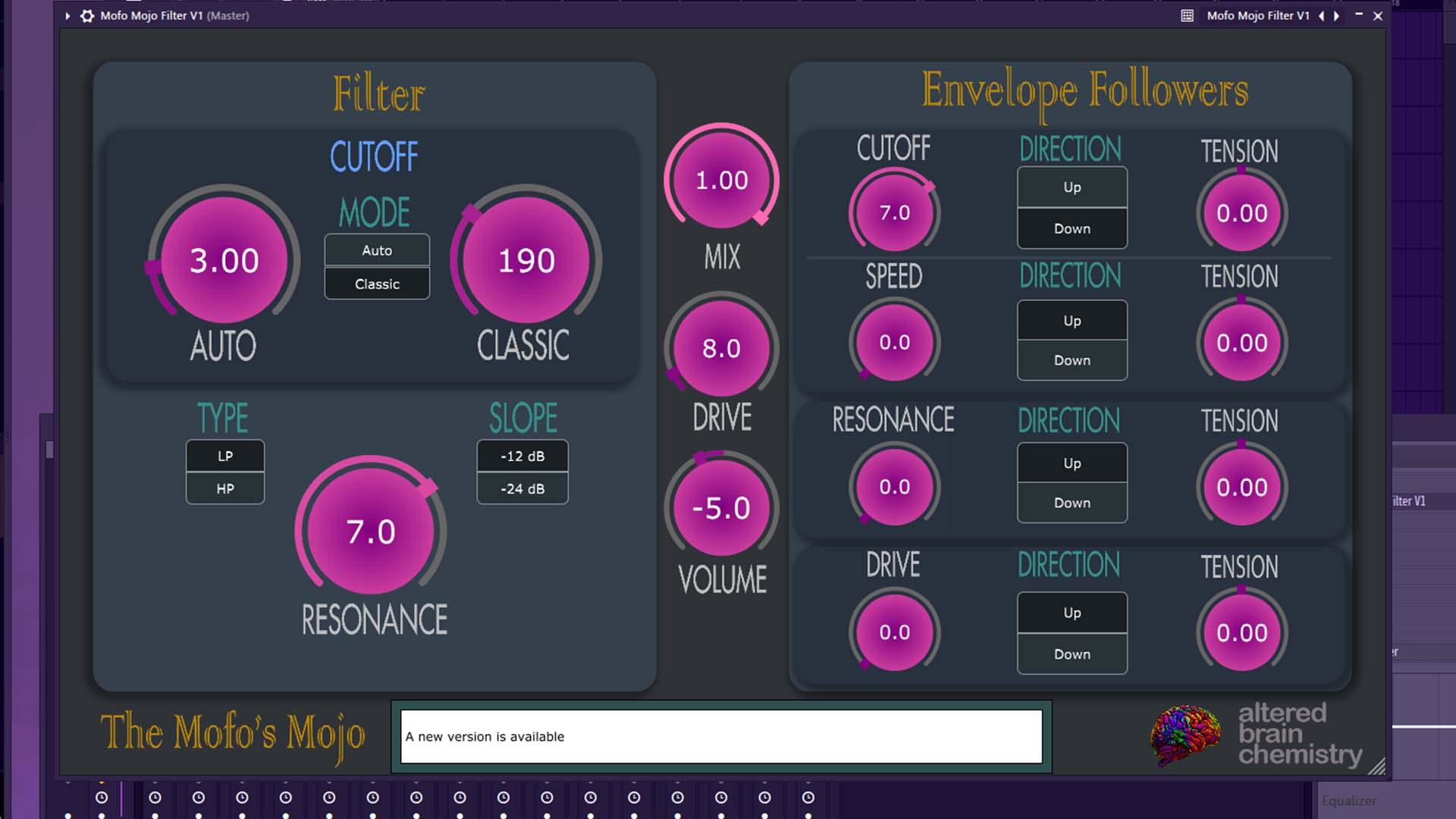
Origins
The Mofo’s Mojo began as a way to capture the character of the MF‑101 in a reproducible, recallable form. I relied heavily on the pedal for auto‑wah and envelope‑driven filtering, but hardware settings aren’t easily documented or restored. I also wanted a digital alternative in case I ever needed to part with the pedal, since I didn’t have another effect that came close to its sound.
R&D
The first prototype lived inside an FL Studio Patcher preset which combined a pair of Fruity Peak Controllers with a pair of filters. From there, I set out to build a proper audio plugin, guided in part by educational material from The Audio Programmer.
For the filter core, I used the open‑source Ladder Filter implementation from JUCE. My research suggested that the MF‑101’s design lineage traces back to the Ladder Filter topology, so this was a natural fit. I then added the essential controls expected from an envelope filter: low‑pass or high‑pass modes, selectable slopes, cutoff bounds, and a nested‑envelope system that mimics patching the MF‑101’s ENV OUT into its AMOUNT input. I also kept familiar mechanics from the original hardware, such as expressing the Amount control in +half‑octaves.
One unique feature I introduced is the “auto mode” for cutoff frequency. This mode uses an FFT to detect the lowest note being played and sets the cutoff frequency as a harmonic multiple of that pitch. For example, if the detected fundamental at time t=1 is 200 Hz, then:
0 harmonics -> 0 Hz
0.5 harmonics -> 100 Hz
1 harmonic -> 200 Hz
2 harmonics -> 400 Hz
and so on. The cutoff is simply the product of the detected fundamental frequency and the selected harmonic ratio.
From there, every mainstream audio plugin had software licensing, so I went on to develop my own licensing service, Software Licensor.
Disclaimer
Moogerfooger and MF-101 are trademarks of Moog Music, Inc. This project is not affiliated with or endorsed by Moog.